




 Arts & Culture
To truly Discover Chile’s Rich History Through Its Art and Architecture is to step directly into a long collision of Andean heritage and European styles. From the remote timber parishes in the rainy south to the concrete high-rises dominating Santiago, the physical environment mirrors a turbulent national narrative. This guide traces how regional creative movements and urban design reveal the grit of the population.
Discover Chile’s Rich History Through Its Art and Architecture: The Evolution of National Art
Tracing the creative output of the Southern Cone requires looking closely at how specific historical eras shaped local identity. Ancient pre-Columbian patterns and indigenous crafts provided an initial groundwork of geometric rigor and close ties to the soil. Eventually, these localized craft methods merged with imported techniques to produce a distinct creative language.
Academics at the Pontifical Catholic University of Chile have mapped how civic monuments mirror the shifts in the nation’s political and economic structures. Analyzing these public works allows us to track the long path from Spanish rule to the modern democratic era.
- Examine the blending of indigenous Mapuche symbols with Spanish Baroque flourishes.
- Notice how the late nineteenth-century mining wealth funded grand, ornate structures across Santiago.
- Decode the political narratives brushed onto neighborhood walls during the turbulent final decades of the twentieth century.
Discover Chile’s Rich History Through Its Art and Architecture: Colonial Foundations
Spanish forces arrived during the sixteenth century, erecting settlements meant to broadcast imperial dominance. While they brought European design blueprints, they relied on local hands and regional materials. This reliance forced an unexpected blending of building traditions.
The historic timber chapels of the Chiloé Archipelago represent this hybrid craftsmanship perfectly. These structures combine European Catholic layouts with local boat-building skills. Carpenters built them entirely of local wood, opting for sturdy wooden pegs rather than iron nails.
Scholars stress that to Discover Chile’s Rich History Through Its Art and Architecture, observers must look closely at how these religious sanctuaries merged opposing worldviews. Sixteen of these timber temples secured UNESCO World Heritage protection in the year 2000. This designation helps protect their delicate structures for future generations.
| Era | Dominant Building Style | Main Construction Materials | Primary Regional Focus |
|---|---|---|---|
| Colonial Era | Spanish Baroque and Mestizo Hybrid | Adobe, Stone, and Local Timber | Santiago and the Chiloé Archipelago |
| Neoclassical Era | French Academic Style | Brick, Ornate Iron, and Marble | Santiago Civic Center |
| Modernist Era | Brutalism and Bauhaus Functionalism | Reinforced Concrete and Plate Glass | Santiago and Valparaíso |
Discover Chile’s Rich History Through Its Art and Architecture: The Modernist Shift
The twentieth century ushered in rapid industrial growth along with a fierce urge to discard colonial design templates. Architects turned their eyes toward European and North American innovations. They eagerly adopted the stark lines of the Bauhaus school and heavy brutalist concrete styles.
Those who seek to Discover Chile’s Rich History Through Its Art and Architecture will find that the middle of the twentieth century brought a sharp departure from old patterns. The United Nations CEPAL Building in Santiago, drafted by Emilio Duhart and finished in 1966, stands as a prime high point of this movement. It employs unfinished concrete to broadcast regional strength and structural honesty.
Modernist artists and architects mirrored this shift, turning away from traditional forms to explore abstract expressionism, innovative structural designs, and gritty social realism. Celebrated figures like Roberto Matta won global attention by splashing psychological states onto massive canvases.
- The Benedictine Monastery Chapel in Las Condes, famous for its subtle manipulation of daylight.
- The creations of Nemesio Antúnez, who installed public paintings directly into subway hubs and government halls.
- The rise of striking graphic art featured on political broadsheets and community campaigns.
Discover Chile’s Rich History Through Its Art and Architecture in Public Spaces
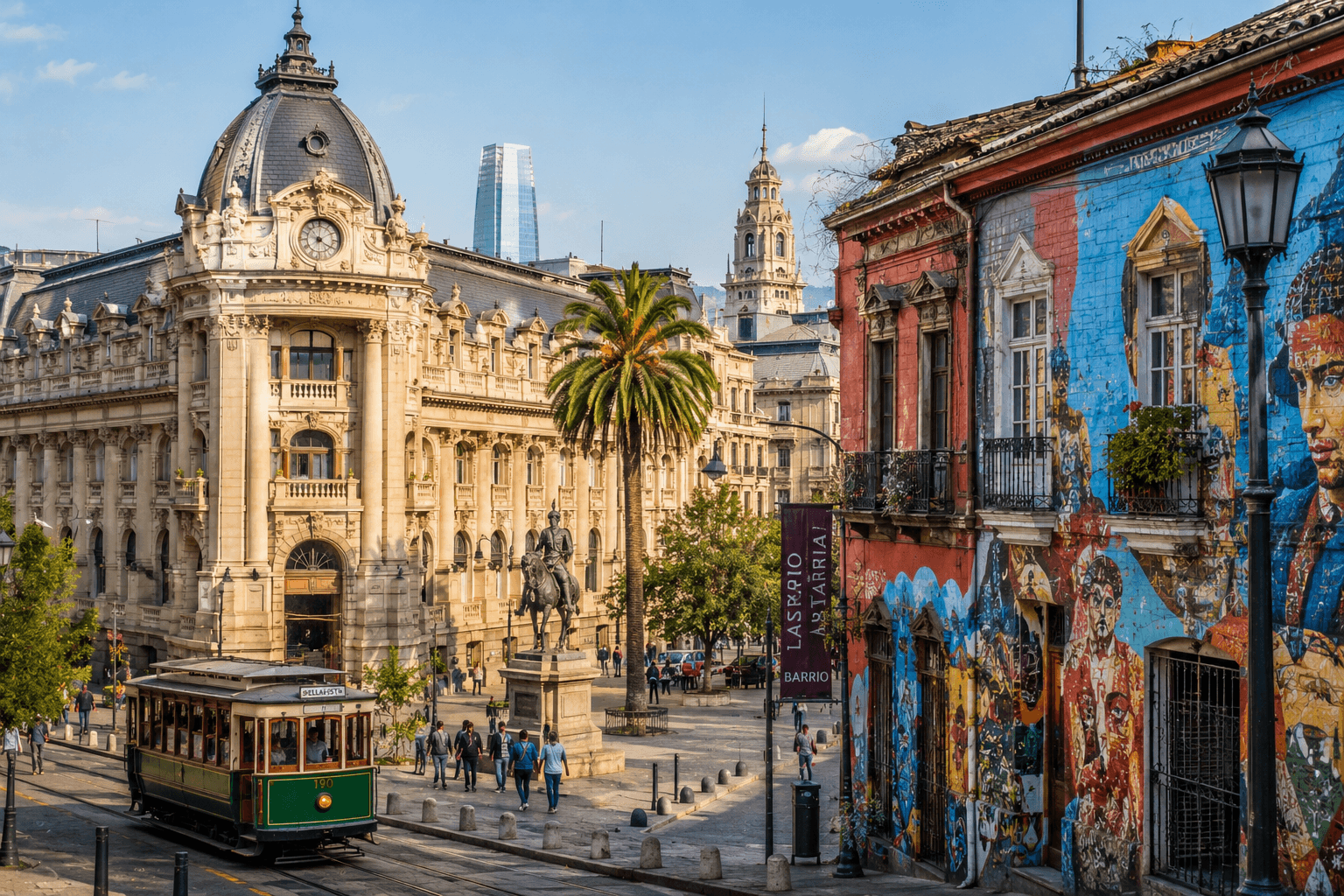
Art in this country has rarely stayed locked inside quiet galleries or private homes. The steep streets of Valparaíso operate as an open-air museum where bold murals cover entire neighborhoods. These paintings depict working-class battles and seafaring victories.
Strolling through these colorful passages allows anyone to Discover Chile’s Rich History Through Its Art and Architecture in a direct, unpretentious way. Travelers can trace the enduring influence of literary giants like Pablo Neruda through these open-air paintings.
From the old building fronts of Cerro Alegre to the massive murals on social housing blocks in San Miguel, street art persists as a crucial outlet for cultural voice. These walls protect the concrete records of political protest and local pride.
Discover Chile’s Rich History Through Its Art and Architecture: Hands-On Advice
Walking through these cities reveals an ongoing conversation between ancestral times and the present day. Every hand-hewn wooden post in Chiloé and each raw concrete column in Santiago tells a tale of cultural endurance.
Ultimately, when you Discover Chile’s Rich History Through Its Art and Architecture, you walk away with a richer understanding of the country’s grit. Reading these physical spaces demands looking past basic tourist attractions to notice the social frictions that built them.


Comments are closed